- Stubbuilder
- Nov 25, 2026
Paystubs or Pay Stubs: Are They Different?
You receive your payment, log into the payroll system, and there is a document that describes how much you got paid and how much was deducted. Some people call this document a pay stub. Others search for “paystub” online. Your uncle, probably, still thinks of it as a check stub.
So are these terms different, or are they just various names referring to the same thing?
The answer is simple: they refer to the same document but also learning about this document is worth a couple of minutes of your attention as this document is capable of saving you from mistakes connected with payroll, loan application denials and tax season the is full of headaches. However, with a free paystub generator, you can organize your earnings and deductions into a clear, easy-to-read pay stub in just a few steps.
Paystubs or Pay Stubs: Which One Is Correct?
Both interpretations are accessible, and they both essentially convey the same meaning. “Pay stub” (two words) is the older version of the expression, and you can expect to see it in formal contexts. “Paystub” (one word), on the other hand, is popular on the Internet, and it can be seen in software interfaces as well as in regular research.
This phenomenon is common in English, as two terms that are used close to each other over time become one. Thus, regardless of which variant you choose, neither will confuse your HR department, your landlord, or your bank.
When you write a formal document, make sure you use the same spelling throughout your text!
Likewise, you may encounter various other terms.
- Check stub
- Paycheck stub
- Payment stub
- Earnings statement
- Wage statement
The names may change, but not the use of the document.
What Is a Pay Stub?
A pay stub is a document that specifies the payment you got for a particular period. It explains your earnings, deductions, and the net amount you received.
You can think of it as a voucher for the job you did. A bank statement might indicate that there was a deposit of $1,287.60, while the pay stub would clarify that it actually was $1,287.60, not $1,600.
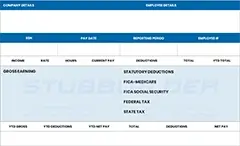
A pay stub generally includes:
- Employer and employee details: names and addresses of the employee and the employer, while in some cases an employee ID is also given.
- Pay period and pay date: Information regarding the payment period and payment date specifies when one is being paid for and the moment of money issuance.
- Hours and pay rate: Hours of work and the pay rate show regular and extra hours worked and hourly or monthly salary.
- Gross pay: Gross pay states total earnings before any deductions.
- All taxes: Consider important taxes, such as federal income tax, Social Security, Medicare, and state or local tax where it applies.
- Deductions: Health insurance contributions, retirement funds, and trade union dues can be added.
- Net pay: The total amount left after deductions is also always stated in the pay stub.
- YTD: Finally, there is also information about the total sum received during the year, listed as YTD, which means you have been paid from January 1 until the payment date.
To illustrate, if you worked for 80 hours in 14 days and your pay was $20 per hour. The tax details in the tables are only for example purposes and may differ depending on your location and other factors.
| Item | Amount |
| Gross pay (80 hours × $20) | $1,600.00 |
| Federal income tax | $140.00 |
| Social Security (6.2%) | $99.20 |
| Medicare (1.45%) | $23.20 |
| State income tax | $50.00 |
| Net pay | $1,287.60 |
What Is a Check Stub?
Essentially, a check stub is just another name for a pay stub. The name has its origin in the paper paychecks that people used to receive, which would be the part of the paycheck that the person would tear off and keep for their records after taking the check to the bank.
Although a paper paycheck no longer exists today because of the advent of direct deposits, the term has not disappeared. This means that if an employer or leasing agent asks you to provide your check stubs, they actually want to see your pay records despite the fact that you may have never received a paper paycheck in your life.
However, this term is sometimes misused and confused with the term “personal check stub,” which is an expression used for the receipt that is left in one’s checkbook.
What Are Check Stubs Used For?
Pay stubs are evidence that you have a job and you have income from it. Such evidence is requested often. And generally, you will need them to do at least the following things:
- Rent a home.
- Apply for some kind of loan (vehicle, mortgage, personal, etc.).
- Confirm your earnings to the authorities as part of income verification for social aid programs.
- Determine the correct amount of taxes to withhold from your paycheck throughout the year.
- Compare the paycheck you receive with the tax form W-2 at the end of the year.
- Resolve an issue about the number of hours of work you actually do.
Banks and landlords will want to see your pay stubs over the last one to three months. However, make sure you ask what exactly is being required of you.
What Are Paycheck Stubs Supposed to Show You?
Paycheck stubs serve three main purposes: What are earnings? What deductions are there? What is the net income?
It’s a good idea to take two minutes and go through the three checks when the paycheck arrives. You need to verify whether the pay is correct. Ensure that the working hours match your notes. If you find deductions, consider asking questions about anything you don’t understand.
Mistakes might happen and are much easier to correct when you deal with one paycheck rather than ten.
What Is a Payment Stub?
A payment stub is a document provided with a payment that may also be a record. In this regard, the term is commonly used in payroll as well.
In a broader sense, a payment stub may mean any document serving as a confirming part of a payment or instructing the recipient what to do next, for example, the bottom part of your utility bill.
Are Employers Required to Give You a Pay Stub?
According to federal law, the answer is no. The U.S.Department of Labor explains that the Fair Labor Standards Act obliges companies to maintain precise records of hours worked as well as salaries but does not require any records to be given to the employee.
In a completely different situation, there are many states that have enacted laws that require the employer to either provide statements of salary pay or make them accessible in one way or another.
How to Get Your Pay Stubs?
A working employee can follow the procedures below to obtain a pay stub:
- One needs to log on to the company’s payroll or HR portal and access their pay stub.
- The next step is to search through their company email for payroll notifications.
- Lastly, an employee can seek help from HR or payroll for copies of these pay stubs.
In case of leaving the job without your pay stub, you have to write a formal request to your previous employer about your pay stub.
If someone is self-employed or trying to run a small business, for example, StubBuilder can assist them in putting everything together in a clear document format. Use only real figures that correspond with your financial records.
Final Thoughts
Pay stub, paystub, check stub, paycheck stub, payment stub: when it comes to wages, they all refer to the same piece of information. It won’t change what you get to take home, but getting a good look at the document may help you catch something that does.
The next time payday is around the corner, and you get a message alerting you of your direct deposit, do not just relax; take some time to review the document and double-check the details. Your future self would appreciate this move whenever preparing an application for a loan.
Paystubs or Pay Stubs: FAQs
1) Is it “paystub” or “pay stub”?
Both terms are correct. Pay stub is more traditional, whereas paystub has gained popularity online.
2) Are check stubs and pay stubs the same?
Yes, the payroll department uses both terms interchangeably.
3) Is a pay stub the same as a paycheck?
No, a check is a physical payment, whereas the pay stub indicates how much was paid.
4) Is a pay stub the same as a W2?
No, a pay stub is for one payment period and provides year-to-date totals, while the W-2 is an annual tax document that summarizes the wages earned and taxes deducted.
5) How long should I keep my pay stubs?
It is best to keep pay stubs until you have received your W-2 and made sure all content matches. If you are applying for loans or working on any wage disputes, you should keep pay stubs for even longer.