- Stubbuilder
- Oct 20, 2026
Payroll Taxes vs Employment Taxes: What’s the Difference?
Payroll taxes and employment taxes sound alike and are often used interchangeably, but they don’t mean the same thing.
For the most part, they do mean the same thing, with a few minor differences. Since knowing the difference can help you understand your pay stub, plan your payroll budget, and steer clear of the IRS, let’s use a check stub maker to see the actual tax deductions.
What Are Payroll Taxes?
Payroll tax refers to a tax determined by the salaries or wages paid to the employees of a business. This tax helps fund various government programs such as Social Security, unemployment insurance, and other federal programs.
Payroll tax includes amounts deducted from the salaries or wages paid to the employees as well as amounts paid by the employer. The money deducted from the salaries of the employees for meeting payroll tax is the answer to people’s question.
What Are Employment Taxes?
In technical language, what do employment taxes refer to? The IRS uses the phrase “employment taxes” to encompass a variety of tax types. Federal employment taxes refer to different types of taxes such as Social Security tax, Medicare tax, FUTA, and federal income tax withholding (also known as federal withholding tax).
In everyday use, the majority of accountants and payroll service providers do not distinguish much between the two concepts, so in most cases, when people talk about “IRS employment tax,” they refer to the same group of taxes, which people normally refer to as payroll taxes.
Payroll Taxes vs Employment Taxes: The Real Difference
The differences are mainly in what and how widely the term is applied.
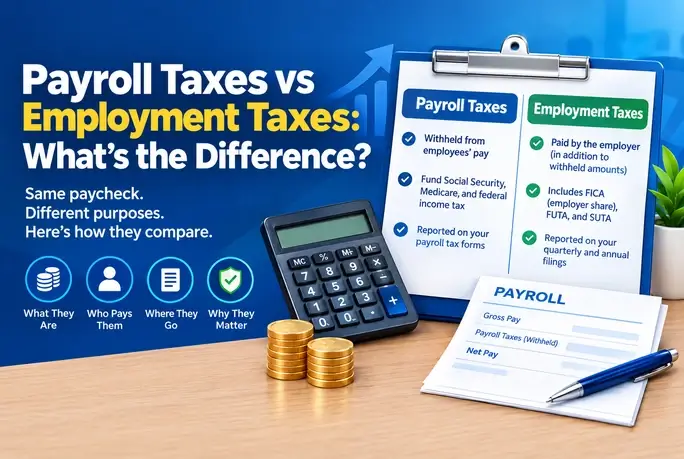
| Payroll Taxes | Employment Taxes |
| Payroll taxes refer to taxes based on the wages given to an employee. They involve Social Security employee tax, Medicare, and unemployment taxes. This is said in conjunction with a discussion on Federal income tax withholding. | Employment taxes are the umbrella term the IRS uses. It covers everything mentioned before plus the withholding that employers handle on behalf of the government. |
There are all references to taxes levied on wages, but how strictly you draw these distinctions depends on whom you ask. For a business owner, the practical takeaway is that it is all taxes, except on it, and you’re on for making the deposits and reporting.
Which Taxes Fall Under Payroll and Taxes?
Here is what sits under the payroll and taxes umbrella.
- The Social Security tax consists of 6.2% of the employee’s salary, up to the salary limit for a particular tax year. The employer must pay the same amount as the employee: 6.2%. For the year 2026, the salary limit is set to $184,500.
- The Medicare tax contributes a portion of 1.45% from the employee and the same 1.45% from the employer without setting any salary limits. The only exceptions are employees who earn over $200,000. This group contributes an additional 0.9%, which is not contributed by the employer.
- Federal income tax withholding is also known as FIT. The amount of FIT tax is calculated based on the employee’s W-4 form and the IRS tax tables.
- The federal unemployment tax (FUTA) is only paid by the employer. The tax amounts to 6% on the first $7,000 earned by each employee, but the employer actually pays only 0.6% due to various tax credits available.
- State and local taxes may include state income tax withholding amount, state unemployment insurance, and sometimes contributions for family leave. Some cities add local taxes as well.
Payroll Taxes Paid by Employer Only
Not all payroll taxes are deducted from the employee’s paycheck. There are some payroll taxes that are only paid by the employer. They are:
- FUTA (Federal Unemployment Tax)
- State Unemployment Tax (SUTA) in most cases
- Employer’s half of Social Security tax and Medicare tax
- Workers’ Compensation premiums, which are technically insurance but frequently included along with employer taxes.
When someone looks for ER taxes, they refer to employer taxes in addition to wages paid to employees. It really costs something. A good rule of thumb is that employers pay around 7.65% on top of employee wages for Social Security and Medicare, excluding unemployment taxes.
How Much Are Payroll Taxes?
In fact, it is one of the frequently asked questions, and there is no clear answer to it.
- If you are an employee, then it seems that 7.65% of payroll tax consists of Social Security (6.2%) and Medicare (1.45%) and is deducted from your gross salary. In addition, on top of that, you will have to add federal income tax withholding, which would be based on several factors, including your salary level, W-4 form, and tax status.
- If you are an employer, it is your responsibility to pay the 7.65% payroll tax, plus you still have to add FUTA and SUTA, which create the total sum of the payroll tax that is going to be paid by the employer. In fact, payroll tax adds up to 10% or more of the wages of your employees,s depending on the state where the employer works.
If you are an employee and you are concerned about how much taxes are taken out of your paycheck, you should bear in mind that for most employees, this approximate sum equals 20% to 30% of their wages, including all taxes that have to be paid at the federal and state levels.
How Are Payroll Taxes Calculated?
There are several steps involved in determining how payroll taxes are calculated:
- The process begins with gross pay, which is the amount that was earned before any deductions were made.
- Pre-tax deductions are accounted for. For the deduction of tax payments, any deductions made, like health insurance premiums or a 401(k) contribution, should be taken into consideration.
- FICA rates are taken into account. The total earnings as per FICA law have to be multiplied by 1.45% for Medicare and 6.2% for Social Security.
- Income tax withholding is accounted for. The employee’s W4 and IRS method are used to find the federal tax amount.
- Income tax withholding is accounted for. The employee’s W4 and IRS method are used to find the federal tax amount.
Payroll Tax vs Income Tax
This is the comparison that trips up the most people, so here is the clean version of payroll tax vs income tax.
| Payroll Taxes | Income Tax | |
| What it funds | Social Security, Medicare, unemployment | General government spending |
| Who pays | Employee and employer (some employer only) | The individual taxpayer |
| How it’s charged | Flat percentage of wages | Progressive brackets |
| Cap | Social Security has a wage limit | No cap on income |
| Applies to | Wages and self-employment earnings | All taxable income |
Payroll Withholding Explained
Payroll withholding refers to the process whereby employers deduct taxes from employees’ paychecks and remit them to the government of the United States. In this process, employers act as tax collectors. Employers withhold the employee’s FICA tax and income tax liability, provide the employer’s share, and submit these tax payments to the IRS at specified intervals, such as monthly or semi-weekly, based on the extent of their tax liability.
It is very important to get the withholding correct in an organization. Under-withholding can leave an employee in tax trouble during tax time, while over-withholding means money given to the government without interest until the employee receives a refund.
Payroll Taxes and the IRS
The IRS sees these obligations in a very serious light and rightly so. The reason for this is that a part of the money collected as taxes from employees is held in trust for the government, which leads to payroll taxes with the IRS being subject to some of the toughest penalties in the tax code.
Employers are required to:
-
- Obtain an Employer Identification Number (EIN)
- Collect the W-4 form from each employee
- Make timely deposits
- File Form 941 every quarter and Form 940 once a year for FUTA
- Issue W-2 forms to employees and submit the forms to the Social Security Administration by the end of January
Late deposits or filing mistakes would lead to penalties and interest. Having clean payroll records will make this job easier.
Why Self-Employed People Pay Differently
Independent contractors, as well as freelancers, don’t have any companies that they can share the costs with. They have to pay the self-employment tax, which is 15.3% (12.4% Social Security and 2.9% for Medicare) and covers both parts. Because of that, the distinction between contractors and employees is vital. The misclassification of employees is a frequent reason for the enormous taxes being charged to business owners.
Why This Matters for Your Pay Stub
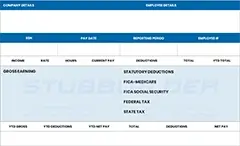
Learning these definitions will make it much easier to read your pay stub template. Each line shows a specific tax type. For small business owners,s making precise pay stubs will help their employees understand the amount of money being withheld from the paycheck and keep the records clear for taxes.
Final Thoughts
Payroll taxes and employment taxes are basically the same thing, and for the vast majority of people, the terms are interchangeable. It is important to understand how payroll taxes work, who pays them, and how they are calculated. It allows employees to have an accurate overview of how much they can take home and employers to comply with the law and avoid unpleasant surprises. Since regulations and thresholds change on an annual basis, it is always wise to verify the current information with the IRS or an accountant before filing.
FAQs:
1) Are payroll taxes and employment taxes the same?
Yes, in practical terms. However, employment tax is known to include payroll taxes and income tax withholding.
2) Do employees pay payroll taxes?
Yes, indeed. Employees have their share of Social Security and Medicare taxes deducted from their salary. The employer pays an equal amount in payroll taxes along with unemployment taxes.
3) Is federal income tax a payroll tax?
Not quite. The tax is withheld through payroll. However, it counts as income tax and goes to the government treasury instead of any specific program.
4) Which payroll taxes does the employer pay alone?
FUTA, most of the state unemployment taxes, and the employer’s share in Social Security and Medicare are included in that tax.