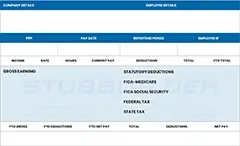
- Stubbuilder
- Jun 12, 2026
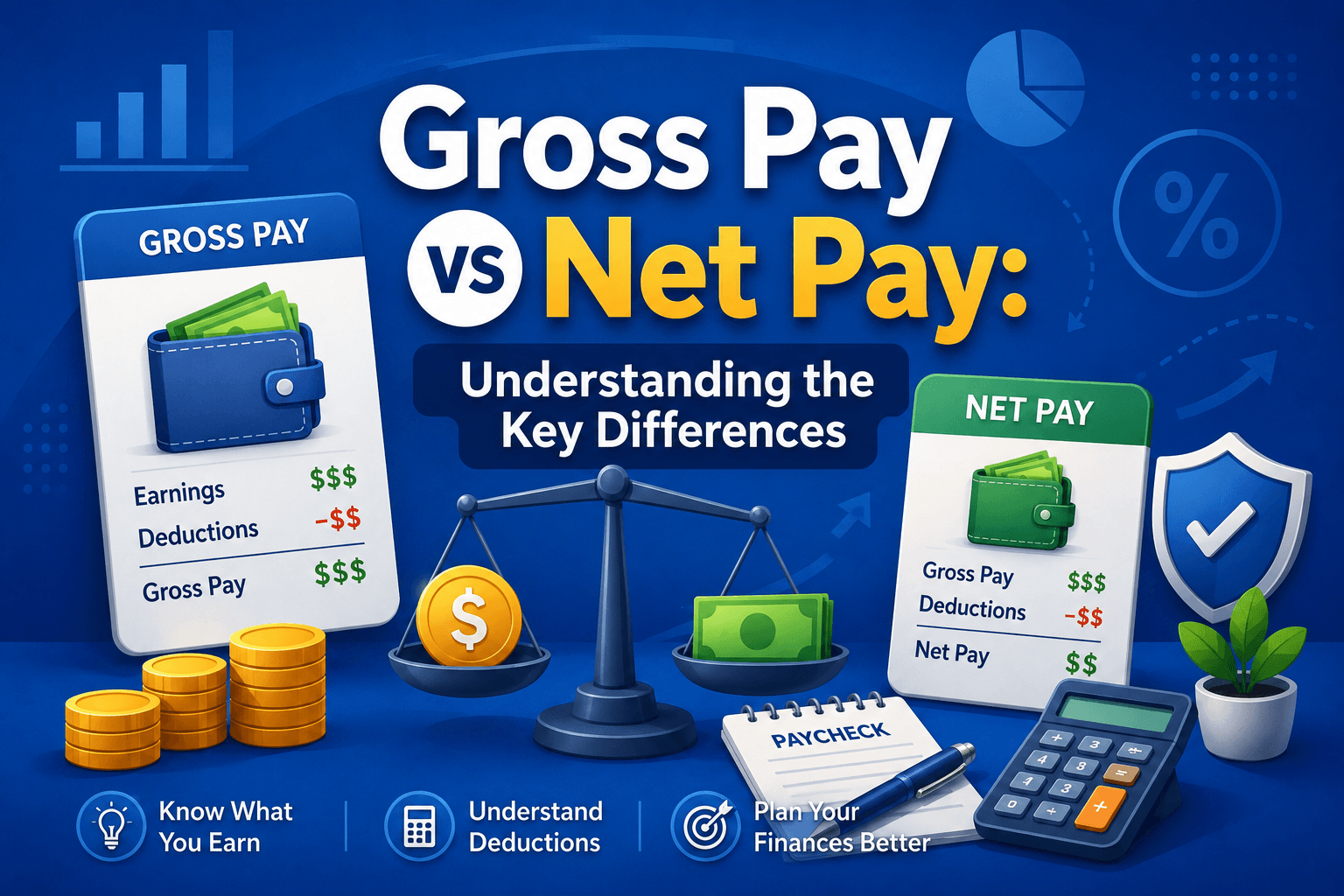
Gross Pay vs Net Pay: What’s the Difference?
Understanding gross pay vs net pay is essential for anyone who receives a paycheck. While gross pay represents the total amount you earn before any deductions, net pay is the actual amount that reaches your bank account after taxes, insurance premiums, retirement contributions, and other deductions are taken out. Knowing the difference can help you better manage your finances, verify your earnings, and understand exactly where your money is going each pay period.
Whether you’re an employee reviewing your paycheck or a business owner creating payroll records with a check stub generator, understanding how gross and net pay are calculated can prevent confusion and payroll errors. If you need to create accurate pay records, a free paycheck stub maker can also help you generate professional pay stubs from StubBuilder that clearly show earnings, deductions, and take-home pay. In this guide, we’ll break down gross pay vs net pay, explain how each is calculated, and show why both figures matter.
What is Gross Income?
Gross pay is the total amount of money an employee earns during a pay period before any deductions are applied. It is the number that is located at the top of your paystub, a whole, uncut figure that your employer agreed to pay you.
When a company offers you a job at $65,000 a year, they’re quoting your gross salary. That’s the starting point. Taxes, retirement contributions all come afterwards.
What is included in Gross Income?
Gross income includes the following:
- Base wages: Your standard hourly rate multiplied by hours worked
- Overtime pay: 1.5x your regular rate for hours beyond 40 per week
- Bonus & commission: Performance-based, driven by additional income
- Tips: Relevant in the hospitality industries
- Shift differentials: Extra pay for working nights and vacations
- Allowances: Meal stipend included in the compensation
What is Net Income?
Net pay, which is commonly called take-home pay, is the amount that actually gets deposited into your bank account after all compulsory and voluntary deductions have been eliminated from your gross pay.
What is included in Net Income?
Net income includes the following:
- Federal income tax withholding
- State and local income taxes
- Social security tax
- Medicare taxes
- Dental and vision insurance premiums
- Retirement contributions like 401(k)
- Flexible Spending Account (FSA)
- Wage garnishments
- Union dues
Gross pay vs Net pay
| Factors | Gross pay | Net pay |
| Definition | Total earnings before deductions | Net pay after all deductions are made |
| Location | Top of the statement | Bottom of the statement |
| Used for | Loan applications, benefits calculations | Day-to-Day budgeting |
| Includes | Base wages, overtime | What remains after taxes and withholdings |
| Larger? | Yes | No |
What is Gross Pay vs Net Pay?
Gross pay vs net pay are the terms that are tied to payroll and individual paychecks; gross income and net income are broader financial terms used in personal finances, business accounting, and tax reporting.
Gross Income Definition
Gross income refers to the total profit of a man or woman or enterprise before any value, tax, or deduction is deducted from all sources. Gross pay for an individual employee generally includes:
- Wages and salaries
- Self-employment or freelance income
- Investment income
- Rental income
- Alimony and certain other payments
For tax purposes, your gross profit is the starting line the IRS uses before pursuing deductions, exemptions, and credits to arrive at your taxable income.
Net Pay Definition
Net income is the money left after all deductions, taxes, and expenses have been taken into account. When it comes to individuals, net income is basically the amount of money you get to keep, or your take-home pay. When it comes to businesses, net income is the money that stays with a company after deducting operating expenses, taxes, interest, and depreciation from its total revenue. It includes:
- Regular earnings
- Overtime pay
- Bonus and commission
- After-tax adjustments
- Final take-home pay
Gross income = Everything earned. Net income = Everything kept.
How is Gross Pay calculated?
Formula: Gross pay = Hours Worked * Hourly Rate
Example:
- Hours worked: 40
- Hourly rate: $25
- Gross pay = 40 * $25 = $1,000
For salaried employees:
Formula: Gross pay = Annual salary / Number of pay periods
Example:
- Annual salary: $52,000
- Paid biweekly: 26 pay periods
How is Net Pay calculated?
Formula: Net pay = Gross pay – Taxes – Other deductions
Example:
- Gross pay: $2,000
- Deductions: Federal Income Tax (FIT): $200
- Social Security Tax: $124
- Medicare Tax: $29
- Health Insurance: $100
- Retirement Contribution: $50
Total Deductions = $503
Net Pay = $2,000 − $503 = $1,497
What reduces Gross Pay to Net Pay?
Deductions fall into two main categories: mandatory and voluntary deductions
Mandatory Deductions
- Federal income tax: This is normally the biggest deduction on your pay stub. The federal income tax system in the U.S. is progressive, which means that higher income earners are subject to higher tax rates. In 2025, the IRS has seven tax brackets with rates of 10%, 12%, 22%, 24%, 32%, 35%, and 37%, and the highest rate is for single filers making over $626,350. The amount withheld from each paycheck is based on your salary and the W-4 form you gave to your employer.
- State income tax: The majority of states impose their own state income tax over and above the federal tax. The tax rates differ greatly, ranging from less than 3% in some states to more than 13% in California for top earners. Only very few states, e.g., Texas, Florida, and Nevada, do not have any state income tax.
- Social security tax: Employees pay 6.2% of gross wages into Social Security. By 2025, it applies to earnings up to $176,100 in the Social Security wage base. Earnings on this cover are not a concern of withholding 6.2%.
- Medicare tax: Employees also pay 1.45% of gross pay to Medicare, without a salary cap. High earners who make more than $200,000 per year pay a further 0.9% Medicare on income above that threshold.
- Local and city tax: Some cities and counties impose their own profit taxes. New York City, as an example, has a city-title gains tax on top of the state and federal taxes. If you are staying or painting in this type of jurisdiction, this provides some other level of containment.
- Wage garnishments: If the court docket has ordered garnishment for unpaid taxes, child support, or student loan defaults, your organization is required by law to make that deduction before issuing your paycheck.
What are the Voluntary Deductions?
The deductions are the ones you elect during onboarding or your company’s open enrollment period:
- Health, dental, and vision insurance premiums: Your share of enterprise-supported health coverage is deducted from your gross pay. These are usually pre-tax deductions, which means they reduce your taxable gains and, in turn, reduce how a whole lot of federal and state taxes are withheld.
- Retirement contributions 401(k): Contributions to a traditional 401(k) are pre-tax, reducing your taxable income. Roth 401 (ok) contributions, by assessment, pop out light-tax. This is where saving even a modest percentage of your paycheck can meaningfully cut your tax liability, even as a long-term wealth builder.
- Health Savings Account and Flexible Spending Account: Both HSA and FSA contributions are pre-tax, presenting a triple tax advantage in the case of an HSA (tax-relaxed contributions, buoyancy, and withdrawals for qualified clinical fees).
- Life and Disability Insurance: Some employers offer those insurance options at a group cost. Premiums can be deducted from pre-or post-tax wages from your paycheck, depending on the type of plan.
- Other Voluntary Deductions: Commuter benefits, gym memberships, and union dues also seem to be in your pay column.
Tips to Maximize Your Net Pay
Do you want to keep what you have earned? Below are legal strategies to follow:
- Maximize pre-tax retirement contributions: Making additional contributions to a traditional 401(ok) directly reduces your taxable income, reducing federal and state withholdings.
- Elect pre-tax health benefits: Choosing agency-assisted health, dental, and imaginative and predictable insurance pre-tax shields that benefit from taxes.
- Open and fund an HSA: Choose organization-assisted fitness, dental, and innovative and predictable insurance pre-tax shields that benefit from taxes.
- Review your W-4 annually: Life changes (marriage, new child, buying a house) have the effect of withholding. Updating your W-4 guarantees proper withholding and can prevent over- or under-tax payments.
- Use a dependent care FSA: If you have young children, this pre-tax account can save thousands annually.
Key Takeaways
Knowing your gross pay vs net pay is one of the most valuable financial lessons you will ever learn. It is between these numbers where the information is. When you know your gross pay, you know your net pay. When you know these concepts, you know how much to spend in each category. Between the two offers, the money for healthcare, retirement, and government programs.
FAQs
1) What is gross salary meaning?
Gross earnings are the entire amount an employee earns before any taxes, benefits, or other payroll deductions are withheld.
2) What is net salary meaning?
Net salary is the amount of money an employee actually receives after all deductions have been taken from their gross salary.
3) What is the difference between gross income vs net income?
Gross pay refers to the total money you get before the government or any other deductions are taken. Net pay (or take-home pay) is the money you get left in your paycheck or bank account after all deductions are made.
4) Is it better to be paid gross or net?
Gross salary is your overall profit before taxes and deductions, which is beneficial for business negotiations. Net pay is your real take-home money after deductions, which you must use for day-to-day budgeting.
5) Why is my gross pay less than my net pay?
Your gross salary is your overall earnings before any deductions. This will be consistently higher than your online pay (take-home pay) because it works from the baseline from which mandatory taxes and voluntary benefits are subtracted.
6) How much is $50,000 net in gross?
If you earn $50,000 in step with the year in California, USA, you will pay $10,242 in taxes. In California, USA, your net salary after taxes is $39,758 for the corresponding year, or $3,313 for the month, step by step.
7) What does $5000 net mean?
$5000 net means you take home exactly $5,000 in actual money after all deductions are taken out. This is your take-home pay.
8) How much is $70,000 a year weekly?
A $70,000 annual salary breaks down to $1,346.15 per week (gross pay) before taxes and deductions, assuming a standard 52-week working year.
9) What’s better, net pay or gross pay?
Net salary is better for setting your day-to-day personal budget, while gross salary is higher for career negotiation and assessing your overall income. One is not objectively better than the other; As an alternative, they serve extraordinary financial features.
10) What is the 373 rule?
The 3-7-3 rule typically refers to a mandatory federal timeline in the United States mortgage process designed to protect borrowers from rushed or predatory lending.