- Stubbuilder
- Apr 28, 2026
How many hours is full time job? A Definitive Guide
While a 40-hour workweek is widely considered the standard for full-time employment, the IRS defines full-time as working at least 30 hours per week or 130 hours per month, but this definition mainly applies to tax regulations rather than general workplace norms.
In case you’re thinking about how many hours count as a full time job in 2026, this detailed guide will help you figure out its definitions, tax regulations, and strategic workforce. If you’re on the lookout for a reliable paystub creator for your business, then you can visit our tool.
What is full time hours?
Full-time hours are a designated position where an employee works a typical number of hours, which is set by the employer. It depends on: country laws, industrial standards, policies of employers, and eligibility criteria.
The Fair Labor Standards Act (FLSA) does not specify a minimum number of hours for full-time work status. But, if employers define full-time work as 40 hours per week, this then breaks down to:
- 8 hours per day
- 40 hours per week
- 160-176 hours per month
- 2,080 hours per year
But some organizations set their own hours threshold. According to the Affordable Care Act, it considers employees working 30 hours per week as full-time for health insurance purposes.
How many hours is full time?
If you are looking for a new job or you have never worked in a full-time position, just before you might be curious about knowing how many hours qualify as a full-time job. A full-time job is one in which you work between 30 and 50 hours a week, with the most common workweek being 40 hours for most full-time employees. Each full-time job will set hours on a case-by-case basis.
For example, if you’re working at a startup company, you might be asked about working more than a standard 40-hour workweek to accomplish every task remaining in the basket. In case you’re working at a well-established firm, you will most likely be required to work 40 hours a week, 8 hours every day from Monday through Friday.
Most companies will look to include information on what is expected of employees in terms of working hours in their employee handbook. Now look at this example, a company might specify that employees are required to work from Monday to Friday from 9 am to 5 pm, another might allow employees to work flexible hours throughout the week, as long as they add up to 40 hours at the end of every week.
Full-Time vs Part-Time (Major Differences)
| Factors | Full-Time | Part-Time |
|---|---|---|
| Working Hours | 30–40+ hours per week | Less than 30 hours per week |
| Benefits | Often includes benefits such as paid leave or health insurance | No benefits in most cases |
| Working Schedule | Fixed and consistent | Flexible |
| Earning Stability | Stable monthly salary | Income might vary based on hours worked |
| Career Growth | Better opportunities for promotions and long-term career growth | Limited growth opportunities |
What are the benefits of full-time hours?
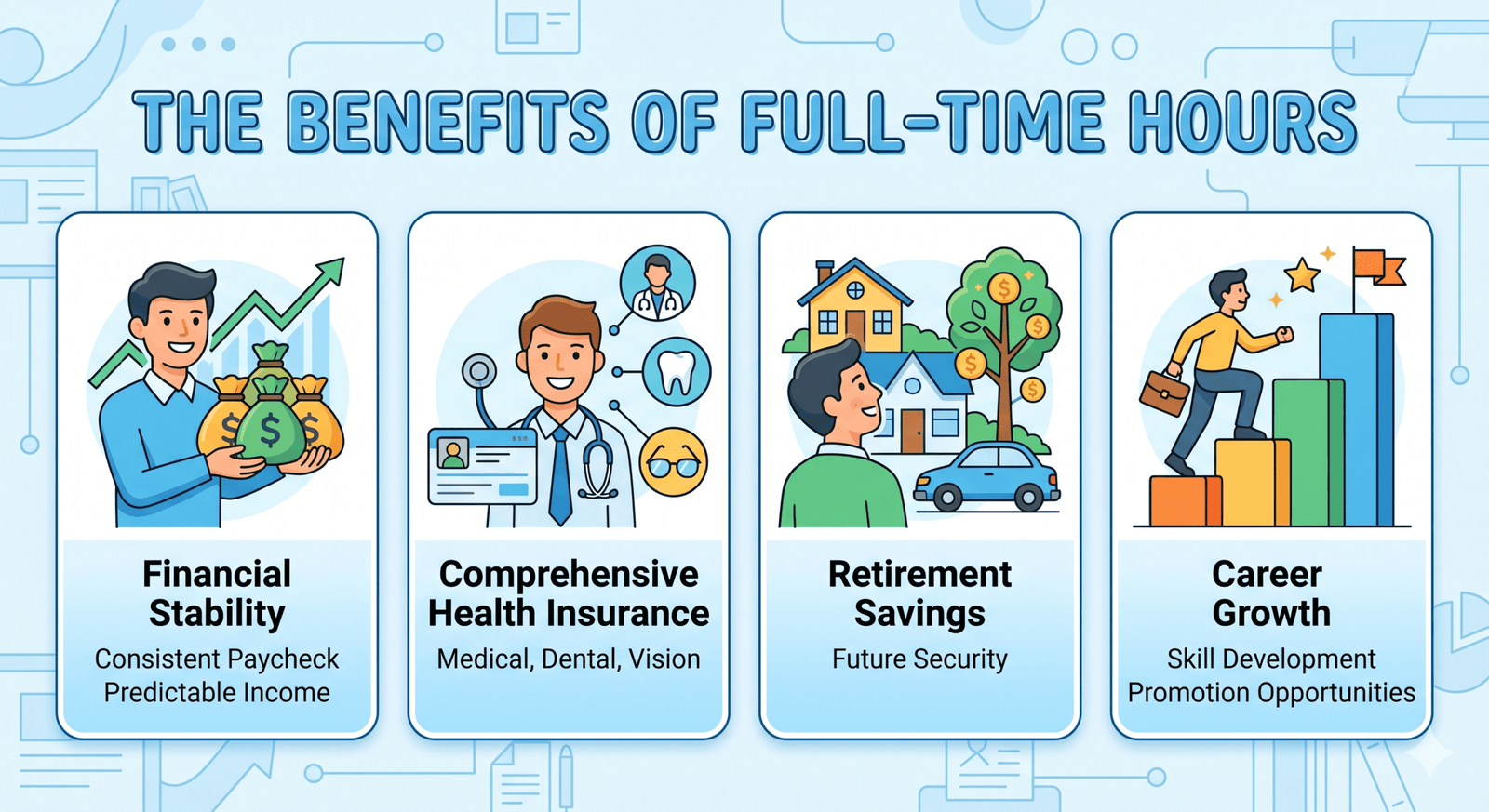
Benefits vary from company to company, but several companies offer their full-time employees the following benefits:
- Sick Leave: Most of the companies offer full-time employees a set number of sick days per year. These can be used when you are sick, and these days might be paid or unpaid.
- Paid time off: All companies provide full-time employees with PTO days every year. The standard number of PTO days is 10 days each year, but every company varies in how many days off it provides to employees.
- Health benefits: There are various types of health benefits that a firm offers to its employees. Common health benefits are: health insurance and dental insurance.
- Paid holidays: Some firms provide employees with paid holidays in addition to PTO. For example, a firm might provide its employees with Christmas Day off and still provide pay for those days.
- Retirement plans: Retirement plans such as 401(k) are only available for full-time employees. Firms might offer the option of choosing to contribute to retirement accounts through a matching program.
- Flexible spending accounts: FSA allows you to contribute to a savings account, which can be used towards medical expenses every year.
- Childcare: Childcare is costly, but some firms help employees by providing cost assistance through free childcare benefits.
What are the eligibility requirements for hiring full-time employees?
Hiring full-time employees can be a great idea when you need immediate coverage for core business operations. For example:
- Customer roles, long-term roles like client support specialists
- Technical positions with learning curves, like data analysts
- Management roles who is responsible for strategic planning
- Core operational staff who handle daily functions that keep your business running
Full-time employees make clear sense, while training costs are high, you need people with extraordinary skills. Hire the team members with a clear plan in mind, give them a head start, and they can provide profitable value to the company. With the right people at the right place, you can strengthen your company environment and drive a more profitable and sustainable growth.
Is working 32 hours considered full-time?
Yes, 32 hours is considered full-time, specifically for benefits eligibility, as the IRS has defined full-time as at least 30 hours per week. However, 40 hours is the standard number of hours; many companies consider 32 hours full-time and an improved work-life balance.
How many hours is a full time job?
A full-time job is considered to be between 30 and 40 hours per week, with a typical 40-hour workweek being the most common. Maximum hours- 48 hours per week, Standard time- 8 to 9 hours per day, Work week- generally 5 or 6 days.
How Many Work Hours in a Year Minus Federal Public Holidays?
There are 11 federal holidays in the US. Working 40 hours per week, your annual total number of holidays will be 2,080 hours. If you take out 11 holiday days, the annual total is 1,992.
Still, certain states have more holidays, and so this figure may change according to your location and the terms of your labor contract.
How many days is full time?
35 to 40 hours per week is considered full-time. In many countries, 40 hours per week is the standard benchmark set. Some employers consider 35 hours per week as full time. The actual working hours are 38-39 hours per week.
How do employers define full-time hours?
Employers define full-time hours as:
Business Needs
- Retail might require longer hours
- IT jobs offer flexible hours
Benefits Eligibility
- 30 hours
- 40 hours
Industry Standards
- Banking long hours
- Tech has flexible hours
Full-time working hours by states
Some states have unique requirements that affect how employers classify workers. Check with the legal and compliance team to confirm which specific rules apply to your business. Below, we have stated the top 3 states:
California
California’s overtime laws are employee-friendly. Non-exempt workers receive overtime after 8 hours in a day and double-time after 12 hours in a day.
Hawaii
Hawaii requires employers to provide temporary disability insurance to employees working 20+ hours per week.
Nevada
Nevada mandates overtime pay after 8 hours in 24 hours for certain employees, regardless of weekly hours worked.
How does StubBuilder help you with full time hours?
When understanding how many hours are in a full-time job, tools like StubBuilder can make managing and presenting those hours much easier and more accurate. StubBuilder allows users to input weekly or monthly working hours, helping clearly reflect whether an employee meets full-time criteria, which is typically between 30 and 40 hours per week.
It automatically calculates salary based on the hours worked, including regular pay and any overtime, reducing the chances of manual errors. In addition, it generates professional pay stubs that include essential details such as hours worked, pay rate, and total earnings, which can serve as reliable proof of full-time employment for purposes like loans, rentals, or verification. This makes StubBuilder especially useful for small businesses, freelancers, and employees who want a simple and efficient way to track, calculate, and document full-time working hours and income in line with standard job expectations.
Key Takeaways
Knowing how many hours are full-time allows you to make more informed career decisions, whether you are job hunting, negotiating your work schedule, or assessing benefits. Although 35 to 40 hours per week is generally considered full-time, the real meaning of a full-time job will depend on the country, industry, and employer policies.
On the other hand, some progressive workplaces are now counting even 30-36 hours as full-time under their flexible work arrangements. What defines full-time is actually a combination of regular working hours, access to benefits, and the employer’s classification.
FAQs
1) Is 36 hours full time?
Yes, 36 hours per week is considered full-time employment.
2) Is working 32 hours considered full-time?
Yes, 32 hours per week is considered full-time employment by many employers and for benefits eligibility.
3) How many hours a week is full time?
Generally, 30 to 40 hours per week.
4) Is full time 8 or 9 hours a day?
A normal workday is 8 hours. In a modern job, a 9-hour day is a standard, which includes an unpaid 1-hour lunch break, resulting in 8 hours of paid work.
5) Is 40 hours a week full-time?
40 hours a week is considered full-time in the U.S., which is structured as 8-hour days.
6) How many hours is 9 to 5 a day?
The 8 intends to be a 40-hour work week.
7) Is a 4-day work week full-time?
Employees follow a 40-hour workweek over four days, generally receiving the same pay as those on a five-day schedule.
8) What is 36 hours considered?
If an employer offers health insurance and retirement plans at 36 hours, it is full-time.
9) Is $2000 a week a good paycheck?
Earning $2,000 weekly results in annual pre-tax earnings of $104,000, which is above the nationwide median and considered reasonable for lots and businesses that depend on the location.
10) Can you live off $20 an hour?
In the U.S., earning $20 or much less per hour can be enough in some cities, yet fall quickly short of what is needed in other areas.