- Stubbuilder
- Aug 20, 2026
How to Prove Income If You Get Paid in Cash
In many jobs, it is normal to get paid under the table, cash in hand: restaurant work, landscaping, house cleaning, construction, tutoring, driving for tips. The paycheck is real. Where it gets dicey is when a landlord, lender, or the IRS wants to see proof of income and you have nothing but cash in an envelope.
The advantage: A regular pay stub is not required to show what you earn. You want to have a paper trail, which you can start building today. However, you can generate the pay stub by using the good pay stub generator tool.
Why Proof of Income Matters for Cash Workers
However, anyone who registers their income without elements of typical employment hits the same wall eventually:
- Apartment Rental – approx 3x monthly rent is a minimum income requirement by most landlords
- How to get an auto loan – lenders need proof you can afford the payment
- Getting a mortgage – underwriters want two years of verifiable income
- Tax filing – you have to report your cash income regardless of W-2
- Eligibility for government benefits – numerous programs request recent income records
All of that becomes more difficult without documentation. It’s not a hard fix, but it does require some itch to the scratch.
What Counts as Proof of Income If You’re Paid in Cash
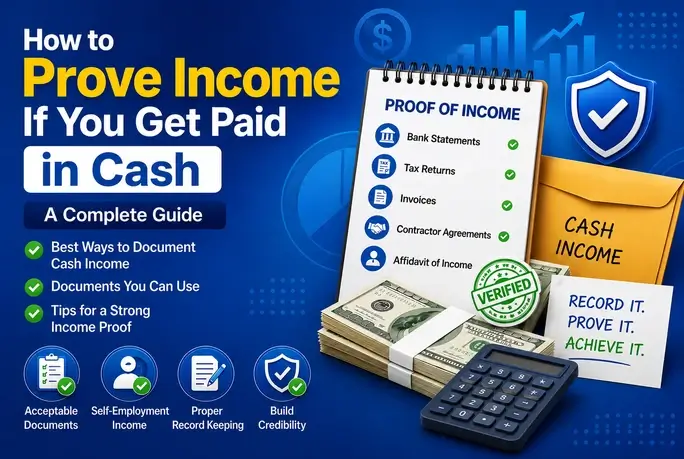
There’s no “correct” proof of income document. Instead, you’re building a case using two or three sources that back each other up. Here’s what’s commonly accepted: check proof of income examples.
1) Bank Statements
Depositing your cash earnings regularly makes your bank statement as proof of income one of the firmest pieces of evidence you possess. A regular pattern of deposits, say, every Friday, will tell a lender/landlord that your income is constant and not a one-off windfall. Bank statements are also used as proof of self-employment income.
2) Self-Generated Pay Stubs
That doesn’t mean you cannot have pay stubs, even if your employer does not issue them. With a pay stub template, you can easily generate an organized stub designating your employer, pay period, hours worked, and gross pay.
A lot of landlords/lenders and benefits offices actually do accept these income verification documents.
3) Spreadsheet
This is the easiest method and is free of charge. Have an ongoing record of four columns: date, who paid you, what the work was, and then the amount. I update it every time I get paid. In effect, these clean, (almost) dated records of your payments over a few months turn into an easily handed-over document.
4) Signed Receipts
Whenever you get paid, write a receipt: the date, the amount, to whom it was paid, and someone who signs that they are paying you. It is particularly handy for one-off jobs, a landscaping gig, a moving job, or tutoring sessions, in which there is no continuous employer relationship.
5) Tax Returns
After you submit a tax return that includes your cash income (check out the next section), that return is one of the most convincing kinds of proof of income to present. It’s a legally binding document, and it heavily affects lenders. If you are self-employed or freelance, this generally means Schedule C attached to your Form 1040, which summarizes your income after business expenses.
6) A Profit and Loss Statement
If you operate a small business, even outside of an official framework (for example, pet-sitting, freelance repair work), a verifiable income statement of profit and loss (P&L), which will quickly summarize your revenue as well as the number of your expenses over a certain time frame.
You can also take the proof of income letter from your employer to prove your income.
How to Report Cash Income on Your Taxes
This matters more than most expect, as a filed tax return is one of the most verified income documents in existence. This is the short answer for how to file taxes when you’re paid in cash:
- Record every payment as it comes in; do not attempt to reconstruct a year’s worth of cash income from memory in April.
- Determine your filing category. When you are self-employed, you will typically be a sole proprietor and file on Schedule C. If you are also subject to self-employment tax (Social Security and Medicare), you will also file Schedule SE.
- Report a gross amount that matches your total, not what is reported to you on the 1099. The 1099 never gets triggered by cash payments from the same client of $600 or fewer, but you are still legally obligated to report your income.
- Pay your taxes while you make money. Because cash income doesn’t have that automatic withholding, many workers find themselves unprepared at tax time. A rule of thumb that is often given is to separate 25–30% of what you make.
- If you cannot pay in full right away, prepare and file on time; the IRS has payment plans available, and failure to file is its own set of penalties beyond whatever tax you owe.
Proof of Income for Specific Situations
Here are some situations you can consider to prove your income.
Proof of Income for an Apartment
In general, landlords want to see that your gross monthly income is approximately three times the rent. If you are getting paid in cash, then apply two or three of these:
- Last 2 to 3 months’ bank statement showing regular, repetitive deposits.
- A pay stub or employer letter, which has been auto-generated
- Most recent tax return (if you filed)
Other landlords, meanwhile, can still involve a higher deposit or even a co-signatory where there is low documentation offered for proof of income for the apartment.
Proof of Income for a Car Loan
Auto lenders primarily just need to verify that you can pay the monthly payment and mostly deny auto loans without proof of income. Normal evidence of income for a car loan, whenever paid in cash, contains:
- Bank statements with regular deposits within the last 3 months
- Pay stubs (self-generated or employer-issued)
- Returns for the last one or two years
Conclusion
You work for cash, and that should not mean running around every single time somebody asks you to prove it. Create a separate account for your income, deposit it within a few days of receipt, and write down every single payment that came through in a notepad or spreadsheet. You can consider these ways if you want to prove your income if you get paid in cash.
Frequently Asked Questions
1) Can a bank statement be used as proof of income?
Yes. Bank statements reflecting predictable monthly deposits are also a generally acceptable proof of income.
2) What can be used as proof of income if I don’t have pay stubs?
Bank statements, tax returns, signed receipts, an income ledger, an employer letter, or a self-generated pay stub will all work as proof of income documents, but in combination.
3) Do I have to report cash tips and income if it’s under $600?
Yes. The $600 limit only matters in relation to whether a payer needs to issue you a 1099.
Also Read:
How to Prove Income for a Mortgage: The Complete Checklist
How to Get a Money Network Paystub?